Pipe Rack & Pipe Support Design for Oil & Gas | KHAAS
Pipe rack engineering for process plants
KHAAS Design & Engineering provides pipe rack and pipe support structural design for oil and gas plants, refineries and petrochemical facilities. We coordinate steelwork, piping reactions, connections and foundation interfaces to develop practical engineering and fabrication deliverables.
What are pipe racks and pipe supports?
Pipe racks are structural frameworks that carry process and utility piping between plant areas. Individual pipe supports transfer loads into those frameworks while allowing or restraining movement as intended by the piping design. A coordinated design treats the piping and supporting steelwork as connected systems.
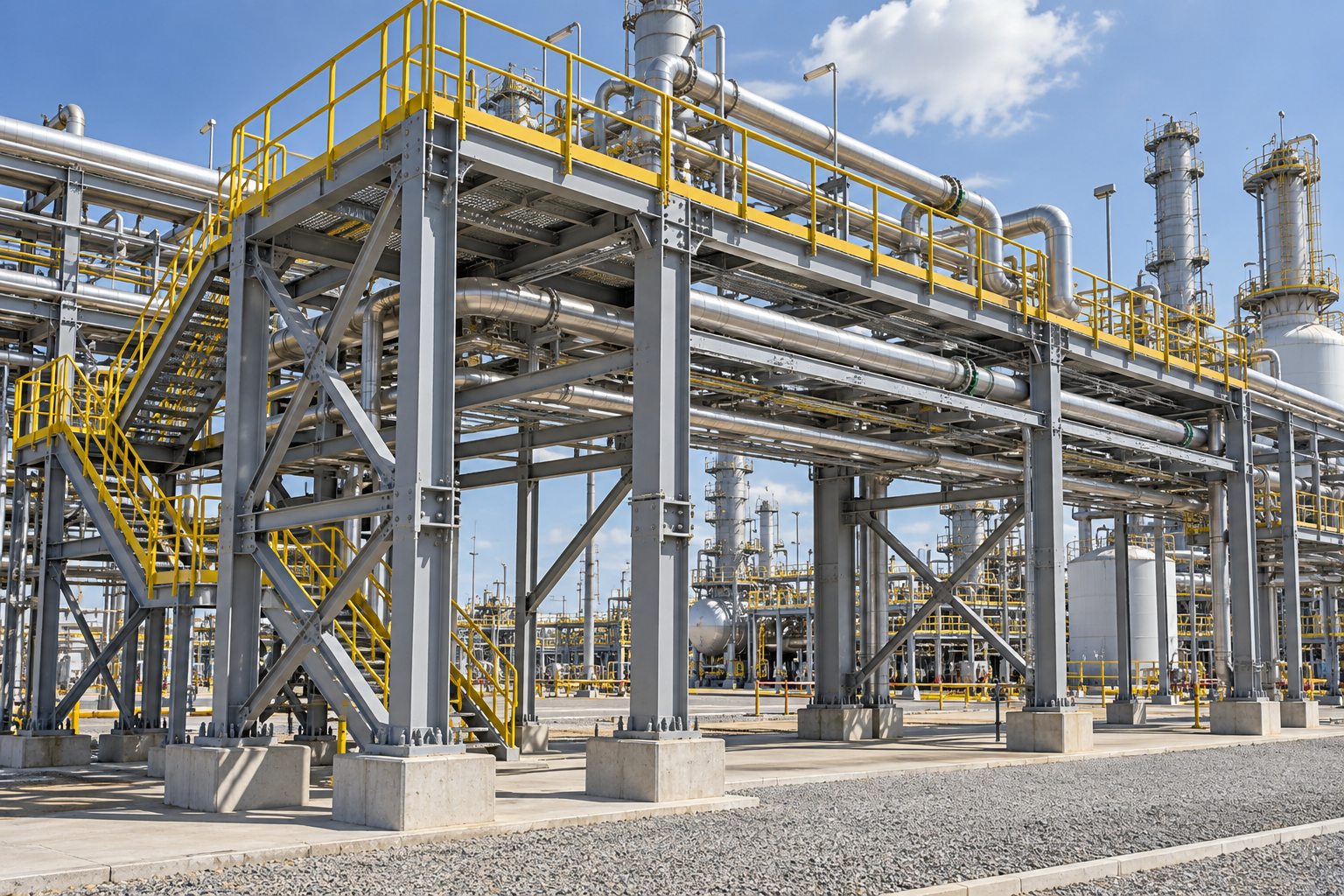
Why piping and structural coordination matters
Support locations and stiffness influence pipe movement and reactions. A guide, anchor or sliding support can create different demands on the rack, its connections and foundations. Incorrect assumptions can lead to unexpected displacement, overstressed components or excessive equipment nozzle loads.
Coordinate support behavior and reactions with pipe stress analysis before finalizing the structural model.
Pipe rack design methodology
Establish the design basis: confirm the site, adopted codes, material grades, rack layout and project criteria.
Collect loads: obtain piping weights, operating contents, test conditions, insulation, cable-tray loads and signed support reactions.
Define the structure: arrange beams, columns and bracing around access, routing and expansion requirements.
Analyze load cases: assess applicable gravity, thermal, wind, seismic and temporary conditions using the agreed combinations.
Check and detail: verify strength, stability, deflection, connections and anchor interfaces.
Coordinate deliverables: align support layouts, calculations, drawings and foundation reactions.
Support types and oil and gas applications
Main and secondary racks for process and utility corridors.
Sleepers and trestles for low-level or heavy piping.
Cantilever brackets and local equipment-area supports.
Pipe shoes, guides and anchors with defined movement requirements.
Hangers or spring supports where the piping design requires them.
The piping engineer defines the intended restraint function. The structural designer checks the steelwork and attachments for the resulting forces and movements.
Engineering and fabrication deliverables
Structural design basis and analysis report.
Rack general arrangements and support layouts.
Member, connection and base-plate details.
Anchor plans and foundation reaction schedules.
Fabrication drawings, material quantities and review responses within scope.
Related services include steel connection design and oil and gas plant foundation design.
Thermal movement, access and future expansion
Review sliding directions, restraint locations and movement clearances together with the piping stress results. Avoid adding a structural restraint that changes the intended piping behavior without a multidisciplinary review.
Reserve access for inspection, valve operation and maintenance. Any allowance for future piping should be quantified in the design basis rather than described as unlimited spare capacity.
Inputs required for pipe rack engineering
Share the plot plan, rack geometry, line list, piping layouts, support reaction tables, operating and test conditions, site loads and project specifications. For an existing rack, include as-built drawings, survey information and the proposed modifications.
Document preliminary assumptions and hold points until critical piping and vendor information is confirmed.
Pipe rack and support design FAQs
Can more pipes be added to an existing rack?
Only after reviewing the existing condition and the capacity of members, connections and foundations for the revised loads.
Are all pipe supports fixed?
No. Supports may allow sliding, guide movement or restrain selected directions. Their function must match the piping analysis.
Which structural code applies?
The project jurisdiction and owner requirements determine the adopted code and edition. These are recorded in the approved design basis.
Request pipe rack and support design
Send your oil and gas plant drawings and design requirements to KHAAS for scope review and a quotation.
Phone: +91 95511 44115
Email: inquiries@khaas-group.com