Specialized Plant Foundation Design for Oil & Gas | KHAAS
KHAAS Design & Engineering provides specialized plant foundation design services for oil and gas facilities, process plants and industrial equipment installations. We support EPC contractors, equipment suppliers and project teams with foundation analysis, reinforced concrete design, anchorage coordination and construction drawings tailored to the agreed scope.
From our Chennai office in India, we support projects worldwide. Our focus is the interface between equipment, structural steelwork and the ground: skid package foundations, equipment pedestals, pipe rack footings, vessel supports and machine foundations where included in the assignment.
What Is Plant Foundation Design?
Plant foundation design establishes how equipment and structural loads are transferred into the soil or piles while meeting the project’s strength, stability, settlement and operating requirements. It combines geotechnical recommendations, vendor information, structural reactions and site constraints into a coordinated engineering solution.
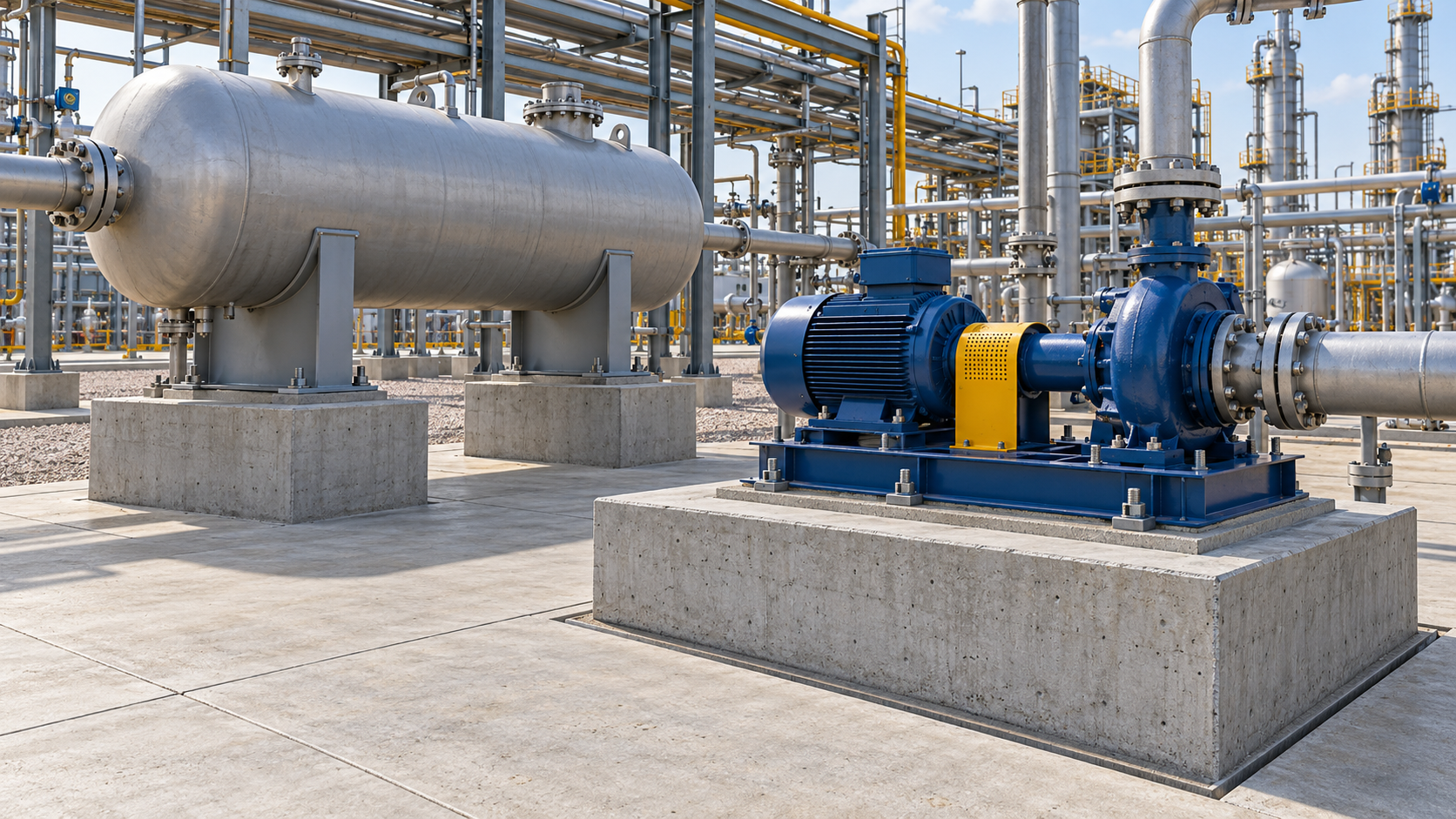
Specialized Foundations for Oil & Gas Equipment
Skid Package and Modular Equipment Foundations
Foundations and pedestals for pump skids, metering packages, chemical injection systems and other modular units. Coordinate support points, base plates, anchor layouts, grout interfaces and approved skid reactions with the package supplier.
Vessel and Heat Exchanger Foundations
Support foundations for horizontal vessels, exchangers and vertical equipment, using approved saddle, skirt or leg reactions. Review empty, operating, test and specified maintenance conditions, together with thermal movement requirements.
Pipe Rack and Pipe Support Foundations
Footings, pedestals and pile caps for pipe racks and independent pipe supports. Coordinate vertical loads, lateral reactions and imposed movements with the structural and piping disciplines.
Tank and Machine Foundations
Assess tank foundation arrangements and equipment foundation systems within the agreed scope. Rotating or reciprocating machinery requires vendor-specific operating data and may require a dedicated dynamic assessment.
Our Plant Foundation Design Methodology
1. Confirm the Design Basis and Site Inputs
Review the project specifications, geotechnical report, site survey, groundwater information and underground service layout. Establish the governing codes, design criteria, responsibility boundaries and required deliverables.
2. Coordinate Equipment and Structural Loads
Obtain approved equipment weights, centres of gravity, support reactions and anchor plans. Identify the relevant empty, operating, test, maintenance, wind, seismic and other specified loading scenarios.
3. Select the Foundation Arrangement
Compare isolated or combined footings, rafts, block foundations and piled solutions against the geotechnical recommendations, settlement limits, footprint and construction constraints. Foundation selection is project-specific.
4. Analyse Stability and Structural Behaviour
Assess bearing pressures, sliding, overturning, uplift and settlement requirements as applicable. Design reinforced concrete for the governing actions and coordinate anchorage, edge distances and load transfer details.
5. Review Equipment Interfaces
Resolve pedestal elevations, grout thicknesses, anchor projections, pockets, embedded items and access for installation. Coordinate differential movement and piping interfaces with the responsible disciplines.
6. Check and Issue Engineering Deliverables
Cross-check calculations, foundation layouts and reinforcement drawings. Record assumptions and outstanding inputs, respond to review comments and assess vendor changes before issuing controlled revisions.
Key Engineering Checks for Plant Foundations
Geotechnical suitability: use site-specific bearing, settlement and pile recommendations; do not rely on a generic soil value.
Stability: assess sliding, overturning, uplift and groundwater effects for the specified combinations.
Concrete design: review flexure, shear, punching shear and reinforcement detailing as applicable.
Anchorage: coordinate tension, shear and concrete load transfer with the selected anchor system and project criteria.
Serviceability: assess movement requirements that affect equipment alignment, piping and connected structures.
Durability and constructability: coordinate exposure conditions, concrete cover, reinforcement congestion and installation tolerances.
Static and Dynamic Equipment Foundations
Static equipment foundations and machinery foundations can have different acceptance criteria. For dynamic equipment, confirm excitation forces, operating speeds, equipment mass properties, soil dynamic parameters and vendor vibration limits before defining the analysis approach.
A foundation that passes static strength checks is not automatically acceptable for vibration. Where required, the scope should include natural frequency and response assessments and coordination with the equipment vendor and geotechnical specialist.
ACI’s report on foundations for dynamic equipment provides relevant guidance and distinguishes dynamic equipment considerations from static foundation design. Governing codes, editions and owner requirements are established for each project.
Typical Foundation Engineering Deliverables
Foundation design basis and input register.
Structural calculation report and stability assessments.
Foundation layout, dimensions and setting-out information.
Pedestal, footing, raft or pile cap reinforcement drawings within scope.
Anchor bolt setting plans and interface details.
Concrete and reinforcement quantities where requested.
Equipment interface comments and controlled drawing revisions.
Information Required for a Quotation
Share the project location, geotechnical report, equipment general arrangement, approved support loads, anchor bolt plan, plot plan and relevant owner specifications. Include the required drawing formats, deliverables, review stages and target schedule.
For machinery, include the vendor’s dynamic data and vibration criteria. For existing foundations, provide available as-built drawings, condition information and survey data. Any investigation, testing or geotechnical work required is defined separately.
Coordinated Engineering for Global Plant Projects
KHAAS supports oil and gas and process industry clients in India, the UAE, Saudi Arabia, Oman, Qatar, Singapore, the USA and other international markets. Our Chennai-based team coordinates with EPCs, equipment vendors, fabricators and civil teams around the agreed project scope.
Foundation interfaces are coordinated with our skid package engineering, pipe stress analysis and structural design services. Explore our chemical injection package skid design article for a related equipment application.
Plant Foundation Design FAQs
How is an equipment foundation different from a building footing?
Equipment foundations must reflect the specific machine or vessel interfaces, load cases, anchorage and movement limits. Some also require dynamic assessment and tighter alignment criteria.
Is a geotechnical report required?
Site-specific geotechnical recommendations are a key input to final foundation design. Preliminary studies may use clearly stated assumptions, but those assumptions must be resolved before finalizing the design.
Can skid foundation design be coordinated with pipe stress analysis?
Yes. Skid reactions, anchor forces and movement assumptions should be coordinated with the piping and structural models. Changes to equipment or support layouts may require both assessments to be revised.
When are piles required?
Piles may be appropriate when shallow foundations cannot meet the project’s bearing, settlement, uplift or lateral performance requirements. Selection depends on the geotechnical recommendations and site constraints.
Request an Oil & Gas Plant Foundation Design Proposal
Contact KHAAS Design & Engineering to discuss your equipment, skid package or plant foundation requirements. Send the available vendor drawings, loads and geotechnical information for a scope review and quotation.
Phone: +91 95511 44115
Email: inquiries@khaas-group.com
Location: Chennai, India — supporting projects worldwide.